

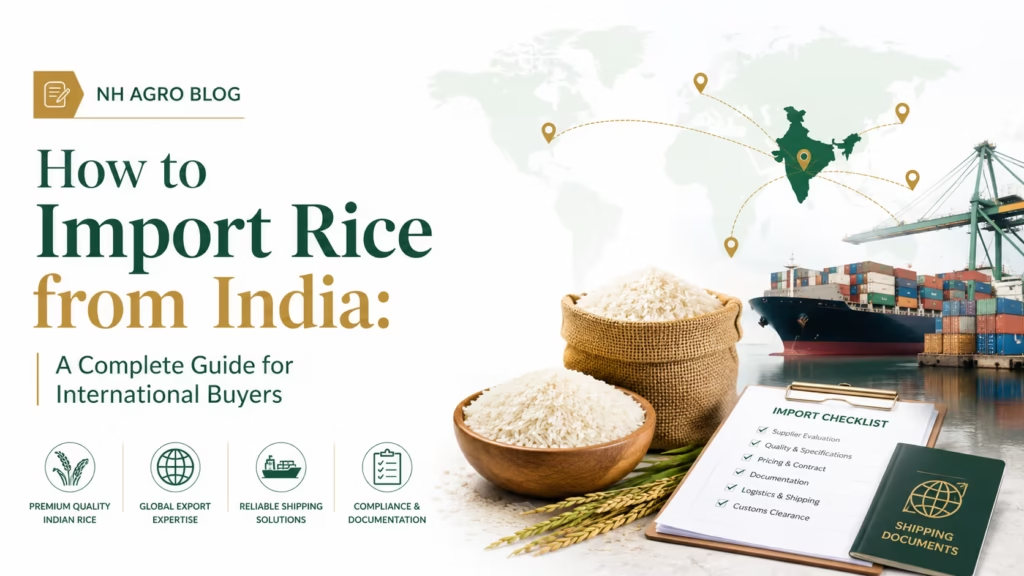
SEO Title: How to Import Rice from India: Complete B2B Guide for International Buyers
Meta Description: Learn how to import rice from India with practical guidance on supplier selection, specifications, pricing, export documentation, FOB/CIF shipments, inspection, packing, and shipment planning for international buyers.
URL Slug: /blog/how-to-import-rice-from-india/
Primary Keyword: how to import rice from India
Secondary Keywords: Indian rice exporter, rice export documentation, rice supplier from India, FOB rice export, CIF rice shipment, import rice from India
Search Intent: Informational and commercial investigation
Category: Agro Commodity Trade
CTA: For specifications, packing options, shipment planning, and export availability, international buyers can contact NH Agro for a rice export quotation.
How to Import Rice from India: A Complete Guide for International Buyers
Introduction
India is one of the major global origins for rice sourcing, serving international buyers across the Middle East, Africa, Asia, and other regions. For importers, wholesalers, food distributors, and trading companies, rice procurement from India is not only about finding a supplier. It requires clear product specifications, reliable quality control, suitable packing, proper export documentation, shipment planning, and transparent trade terms.
Many buyers search for how to import rice from India because the process can appear complex at first. The buyer must understand rice varieties, broken percentage, grain type, packing requirements, payment terms, FOB or CIF pricing, inspection procedures, and destination documentation needs.
This guide explains the practical rice import process from a B2B buyer’s point of view. It is designed for international rice importers in the UAE, Middle East, and West Africa who want to work with an Indian rice exporter or rice supplier from India in a structured and professional manner.
Why This Matters for International Rice Buyers
Rice is a high-volume commodity where small mistakes in specification, packing, documentation, or shipment planning can create commercial problems. A buyer may receive rice that does not match the target market, bags that are not suitable for distribution, documents that delay clearance, or pricing terms that are not clearly understood before shipment.
For international buyers, especially importers and distributors handling container-level orders, the import process must be managed carefully from inquiry to delivery.
| Buyer Concern | Why It Matters | Practical Control Point |
|---|---|---|
| Rice variety | Determines market suitability, cooking use, and buyer acceptance | Confirm variety, processing type, and sample quality before order |
| Broken percentage | Affects price, appearance, and end-use segment | Define broken percentage clearly in the specification sheet |
| Packing | Impacts handling, storage, branding, and distribution | Approve bag size, material, artwork, and markings before production |
| Documents | Incorrect documents may delay customs clearance or bank processing | Share document requirements before shipment |
| Trade terms | FOB and CIF define cost, responsibility, and logistics control | Confirm Incoterm, port, freight responsibility, and insurance scope |
Understanding India’s Rice Export Landscape
India as a Rice Sourcing Origin
India has a wide rice production and milling base, with different varieties grown, processed, and packed for domestic and export markets. Export buyers generally work with rice exporters, processors, merchant exporters, or sourcing companies that coordinate procurement, milling, sorting, packing, documentation, and shipment.
A professional Indian rice exporter should be able to help buyers with product selection, specification finalization, export-grade packing, pre-shipment inspection coordination, container stuffing coordination, commercial and shipping documents, FOB or CIF quotation support, and shipment communication.
The buyer should not evaluate an exporter only by price. In rice trade, clarity, documentation, consistency, and execution are equally important.
Basmati and Non-Basmati Rice Categories
Indian rice exports are commonly divided into two broad groups: basmati and non-basmati rice.
Basmati rice is generally known for long grain, aroma, elongation after cooking, and use in premium food service, retail, and household consumption. Common basmati varieties include 1121 Basmati, 1509 Basmati, and 1718 Basmati.
Non-basmati rice includes varieties such as IR64, Swarna, PR11, Sona Masoori, parboiled rice, white rice, broken rice, and other regional varieties. These are commonly used by bulk buyers, wholesalers, food service suppliers, institutional buyers, and mass-market distributors.
| Rice Category | Common Buyer Segment | Common Commercial Focus |
|---|---|---|
| Basmati rice | Retail brands, food service distributors, premium importers | Grain length, aroma, aging, cooking quality, packing presentation |
| Non-basmati white rice | Wholesalers, food distributors, general commodity buyers | Broken percentage, moisture, sorting, polishing, price segment |
| Parboiled rice | Bulk importers, West African buyers, institutional channels | Color, grain firmness, broken percentage, consistency |
| Broken rice | Processors, wholesalers, price-sensitive segments | End use, broken level, cleanliness, packing, quantity |
Common Buyer Segments in UAE, Middle East, and West Africa
International buyers importing rice from India may include importers and trading companies, wholesale rice distributors, supermarket and retail suppliers, food service distributors, re-export companies, bulk commodity traders, private label rice brands, institutional supply contractors where applicable, and food manufacturers or processors.
In UAE and GCC markets, buyers may require basmati and non-basmati varieties depending on retail and food service demand. In West African markets, parboiled rice, broken rice, and non-basmati rice varieties are commonly discussed by commodity buyers, subject to specific buyer requirements and destination market preferences.
Key Rice Export Ports from India
Rice shipments from India may move through different ports depending on the supplier location, buyer destination, freight availability, and commercial terms. Common Indian export ports for agro commodities may include Mundra, Nhava Sheva, Kandla, Chennai, Kolkata, Haldia, and other ports depending on the cargo origin and route.
The final port should be agreed between buyer and exporter based on product sourcing location, container availability, freight route, destination port, shipment schedule, FOB or CIF terms, and buyer’s preferred logistics arrangement.
Step-by-Step Process to Import Rice from India
Importing rice from India becomes easier when the buyer follows a clear process. The table below shows the import journey from initial requirement to destination clearance.
| Step | Buyer Action | Exporter Support | Output |
|---|---|---|---|
| 1 | Define rice requirement | Suggest suitable product category | Clear inquiry |
| 2 | Choose rice variety | Explain available options | Product shortlist |
| 3 | Share specifications | Confirm technical feasibility | Specification sheet |
| 4 | Request quotation | Provide FOB or CIF quote | Commercial offer |
| 5 | Confirm trade terms | Clarify seller responsibility | Agreed shipment basis |
| 6 | Review payment terms | Share acceptable payment structure | Payment agreement |
| 7 | Finalize packing | Coordinate bag type and labeling | Approved packing plan |
| 8 | Arrange inspection | Coordinate inspection or loading supervision | Quality approval |
| 9 | Confirm documents | Prepare export-side documents | Document set |
| 10 | Prepare import clearance | Share shipment and document updates | Destination clearance readiness |
Step 1: Define Your Rice Requirement Clearly
The first step is to define the exact rice requirement. A general inquiry such as “send rice price” is usually not enough for an accurate quotation.
A buyer should mention rice variety, basmati or non-basmati category, processing type, broken percentage, moisture requirement, sortex requirement, polishing requirement, packing size, bag type, quantity, destination port, preferred trade term, payment term, private label requirement, and inspection requirement if any.
Step 2: Choose the Right Rice Variety
The buyer should choose the rice variety based on market demand, cooking preference, price segment, and distribution channel.
1121 Basmati may be suitable for premium basmati segments. 1509 Basmati may be selected for certain value-conscious basmati buyers. IR64 parboiled rice may be relevant for buyers seeking parboiled non-basmati rice. IR64 white rice may be used for general consumption markets. Swarna rice, PR11 rice, Sona Masoori rice, 25% broken rice, and 100% broken rice may be considered depending on buyer requirements and destination market use.
Step 3: Share Technical Specifications with the Exporter
Specifications are the commercial language of rice trade. Without specifications, two suppliers may quote different products under the same variety name.
Buyers should confirm average grain length, broken percentage, moisture percentage, foreign matter limits, admixture limits, chalky grain tolerance where relevant, damaged or discolored grain tolerance, sortex-cleaned or non-sortex requirement, polishing level, crop year or aging requirement where relevant, packing requirements, and inspection requirement.
Step 4: Request a Formal Quotation
After the specification is clear, the buyer should request a formal quotation from the rice supplier from India.
A proper quotation should ideally mention product name, variety, specification, packing, quantity, price basis, currency, port of loading, destination port if CIF or CFR, payment term, shipment period or availability indication, validity of offer, inspection terms, documents provided, and any exclusions or special conditions.
Step 5: Confirm Trade Terms: FOB, CIF, CNF, or CFR
Trade terms define who handles different parts of the shipment cost and risk. In rice export, buyers commonly discuss FOB and CIF.
FOB rice export means the seller generally handles the cargo up to loading on board at the Indian port, while the buyer arranges ocean freight and insurance depending on the agreed contract. CIF rice shipment means the seller generally arranges cost, insurance, and freight up to the destination port, subject to agreed contract terms.
Step 6: Review Payment Terms
Payment terms must be discussed carefully. Common payment structures in agro commodity trade may include advance TT, partial advance and balance against documents, TT against scanned documents, Letter of Credit at sight, mixed TT and LC terms, and other agreed banking arrangements.
The payment term depends on buyer-seller relationship, transaction history, country risk, bank comfort, order value, and exporter policy.
Step 7: Confirm Packing and Branding Requirements
Packing is very important in rice export. Rice may be packed in 25 kg or 50 kg PP woven bags, BOPP bags, non-woven bags, jute bags, or private label bags depending on the buyer’s market and distribution plan.
Buyers should confirm bag size, bag material, printed or plain bags, private label artwork, language requirements, marking details, production approval before packing, palletized or non-palletized shipment if required, and container load planning.
Step 8: Arrange Inspection and Quality Approval
Inspection protects both buyer and seller. It confirms whether the cargo matches the agreed specification before shipment.
Inspection may include supplier’s internal quality check, buyer sample approval, third-party inspection, container stuffing supervision, weight verification, moisture testing, visual inspection, and bag and marking verification.
Step 9: Finalize Export Documentation
Rice export documentation is a key part of the transaction. Incorrect or delayed documents can create customs clearance problems at destination.
Common rice export documents may include commercial invoice, packing list, bill of lading, certificate of origin, phytosanitary certificate, fumigation certificate, inspection certificate where applicable, weight and quality certificate where applicable, insurance certificate for CIF shipments, and any buyer-specific or destination-specific documents.
Step 10: Track Shipment and Prepare for Import Clearance
Once the shipment is loaded, the buyer should track the vessel and prepare for destination import clearance. The buyer should coordinate with their clearing agent before the vessel arrives.
Important actions include checking draft documents before final issuance, confirming consignee and notify party details, tracking shipment status, preparing import permits or destination documents where applicable, coordinating with customs broker or clearing agent, arranging duty, port charges, and local transport, and planning warehouse receiving and distribution.
Choosing the Right Rice Supplier from India
Company Background and Export Experience
Buyers should check whether the supplier understands export procedures, B2B documentation, packing standards, shipment coordination, and communication requirements. A supplier may have a good product but weak export handling. For international buyers, both product and execution matter.
Product Range and Sourcing Network
A serious rice supplier from India should be able to offer multiple rice varieties or guide buyers to the correct category based on destination demand. NH Agro works across rice and allied agro commodities, allowing buyers to discuss rice along with pulses, lentils, spices, edible oils, oil seeds, sugar, wheat flour, and other products where relevant.
Quality Control Process
Buyers should ask how quality is checked before shipment. Important questions include whether the rice is sortex-cleaned, whether moisture is checked before packing, whether broken percentage is controlled, whether samples are shared before shipment, whether third-party inspection is possible, whether container stuffing is supervised, and whether bags are checked before loading.
Communication and Documentation Capability
In export trade, slow or unclear communication can create avoidable delays. A capable exporter should respond clearly on product, price, shipment, documentation, and payment terms. The exporter should also understand how to prepare commercial documents accurately.
Packing Flexibility and Private Label Support
Many international buyers need private label packing for their market. The supplier should be able to coordinate bag design, artwork approval, packing size, and markings based on buyer instructions. Buyers should confirm minimum quantity, bag printing lead time, and artwork specifications before finalizing private label orders.
Rice Varieties Commonly Imported from India
| Rice Variety | Category | Common Buyer Focus | Suggested Link |
|---|---|---|---|
| 1121 Basmati Rice | Basmati | Long grain, aroma, aging, elongation, premium packing | 1121 Basmati rice |
| 1509 Basmati Rice | Basmati | Price-quality balance, grain length, cooking result | 1509 Basmati rice |
| 1718 Basmati Rice | Basmati | Processing type, aroma, grain parameters | 1718 Basmati rice |
| IR64 Parboiled Rice | Non-basmati | Parboiled quality, broken percentage, color, moisture | IR64 parboiled rice |
| IR64 White Rice | Non-basmati | White rice quality, sortex cleaning, polishing | IR64 white rice |
| Swarna Rice | Non-basmati | General non-basmati segment, specification consistency | Swarna rice |
| PR11 Rice | Non-basmati | Grain length, cooking characteristics, packing | PR11 rice |
| Sona Masoori Rice | Non-basmati | Regional consumer demand, polishing, broken percentage | Sona Masoori rice |
| 25% Broken Rice | Broken rice | Wholesale and price-sensitive segments | 25% broken rice |
| 100% Broken Rice | Broken rice | Food processing, industrial use, specific buyer requirements | 100% broken rice |
Rice selection depends on buyer market, price segment, cooking preference, and distribution model. Buyers should not rely only on the variety name. Each product should be evaluated through written specifications, sample approval where required, and agreed inspection terms.
Key Rice Specifications Buyers Should Confirm
Rice import success depends heavily on specifications. A buyer should not confirm an order based only on the rice name.
| Specification Parameter | Commercial Importance | Buyer Action |
|---|---|---|
| Grain length and variety | Affects appearance, cooking quality, and product positioning | Confirm variety and grain parameters before quotation |
| Broken percentage | Influences price, quality perception, and buyer segment | Specify required broken percentage clearly |
| Moisture content | Affects storage and shipment stability | Agree acceptable moisture limit before shipment |
| Foreign matter | Impacts cleanliness and market acceptance | Define tolerance level and cleaning requirement |
| Admixture | Important for variety purity and premium positioning | Confirm acceptable admixture limits |
| Sortex cleaning | Improves appearance and removes defective grains | State whether sortex-cleaned rice is required |
| Polishing level | Affects final appearance and buyer preference | Confirm silky polish, double polish, or specific finish |
| Processing type | Changes color, texture, and cooking behavior | Specify white, raw, parboiled, steam, sella, or golden sella |
| Crop year and aging | Relevant for certain basmati and premium rice buyers | Confirm crop and aging requirement where applicable |
| Packing size and bag type | Affects handling, branding, and distribution | Finalize packing before production |
Understanding FOB Rice Export from India
What FOB Means in Rice Export
FOB stands for Free on Board. Under an FOB rice export arrangement, the Indian exporter generally handles cargo up to loading on board the vessel at the agreed Indian port, according to the agreed contract.
The buyer usually arranges ocean freight, insurance, and destination-side clearance. The exact responsibilities should always be confirmed in the contract.
Buyer and Seller Responsibilities Under FOB
| Responsibility Area | Usually Handled by Seller Under FOB | Usually Handled by Buyer Under FOB |
|---|---|---|
| Rice sourcing and processing | Yes | No |
| Export packing | Yes | No |
| Transport to Indian port | Yes | No |
| Export customs clearance | Yes | No |
| Ocean freight booking | No | Yes |
| Marine insurance | Usually no | Usually yes, if required |
| Import customs clearance | No | Yes |
| Destination local delivery | No | Yes |
When FOB Is Suitable for Rice Importers
FOB may be suitable when the buyer has their own freight forwarder, wants control over shipping line selection, can negotiate freight independently, has experience in import logistics, and wants to compare product cost separately from freight cost.
Common FOB Ports for Indian Rice Shipments
FOB rice export may be quoted from ports such as Mundra, Kandla, Nhava Sheva, Chennai, Kolkata, Haldia, or other ports depending on cargo origin and shipment planning. The exporter and buyer should confirm the port before final pricing.
Understanding CIF Rice Shipment from India
What CIF Means in Rice Shipment
CIF stands for Cost, Insurance, and Freight. In a CIF rice shipment, the seller generally arranges the goods, export process, freight, and insurance up to the named destination port, subject to the agreed contract.
The buyer remains responsible for destination clearance, duties, port charges, and onward delivery unless otherwise agreed.
Buyer and Seller Responsibilities Under CIF
| Responsibility Area | Usually Handled by Seller Under CIF | Usually Handled by Buyer Under CIF |
|---|---|---|
| Rice sourcing and processing | Yes | No |
| Export packing | Yes | No |
| Export clearance | Yes | No |
| Ocean freight arrangement | Yes | No |
| Marine insurance | Yes | No |
| Import clearance | No | Yes |
| Destination port charges | No | Yes |
| Local delivery | No | Yes |
Freight, Insurance, and Destination Port Planning
CIF pricing changes with freight conditions, shipping line availability, port congestion, route, container availability, insurance, and shipment timing. Buyers should request updated CIF pricing for the exact destination port and quantity.
A CIF quotation should not be assumed valid for every destination or shipment date.
When CIF May Be Better for New Importers
CIF may be suitable when the buyer does not have a strong freight agent, wants landed cost visibility up to destination port, is new to importing rice from India, prefers the exporter to coordinate freight, and wants simpler shipment coordination.
However, buyers should still coordinate destination customs clearance with their local clearing agent.
Rice Export Documentation Required from India
Rice export documentation must be accurate and aligned with buyer and destination requirements. Document requirements may vary by destination, buyer, bank, and shipment terms.
| Document | Purpose | Buyer Note |
|---|---|---|
| Commercial Invoice | Shows seller, buyer, product, quantity, price, trade term, and shipment details | Must match contract and banking requirements |
| Packing List | Shows bag count, net weight, gross weight, packing size, and container details | Useful for customs, port, and warehouse verification |
| Bill of Lading | Confirms cargo loading and shipping details | Consignee and notify party details must be checked carefully |
| Certificate of Origin | Confirms country of origin | May be required for customs, bank, or destination procedures |
| Phytosanitary Certificate | Relates to plant health requirements for agricultural goods | Requirement should be verified by destination |
| Fumigation Certificate | Confirms fumigation where required | Need depends on buyer or destination requirement |
| Inspection Certificate | Confirms inspection scope and findings where applicable | Should be agreed before shipment |
| Weight and Quality Certificate | Confirms shipment weight and quality parameters where required | Buyer should specify if required |
| Insurance Certificate | Commonly used for CIF shipments | Coverage and beneficiary details should be reviewed |
| Destination-Specific Documents | Additional documents required by buyer, bank, or local authority | Buyer should verify before shipment |
Commercial Invoice
The commercial invoice contains the seller, buyer, product description, quantity, price, trade term, currency, and shipment details. It is one of the main documents used for customs and payment.
Packing List
The packing list shows bag count, net weight, gross weight, packing size, and container details. It helps customs, port authorities, and warehouse teams verify the shipment.
Bill of Lading
The bill of lading is issued by the shipping line or carrier. It confirms that cargo has been loaded and includes details such as shipper, consignee, notify party, vessel, port of loading, port of discharge, and container details.
Certificate of Origin
The certificate of origin confirms the country of origin of the goods. Buyers may require it for customs clearance, bank documentation, or destination trade procedures.
Phytosanitary Certificate
A phytosanitary certificate may be required for agricultural commodities to confirm plant health-related compliance. Requirements should be checked based on destination rules and shipment type.
Fumigation Certificate
A fumigation certificate may be required when cargo or packing materials are fumigated as per buyer or destination requirements. The need for fumigation should be confirmed before shipment.
Inspection Certificate
An inspection certificate may be issued by a third-party inspection agency or accepted inspection body when required by the buyer, bank, or destination market.
Weight and Quality Certificate
A weight and quality certificate may be requested to confirm shipment quantity and agreed quality parameters. Buyers should specify whether this is required before finalizing the transaction.
Insurance Certificate
For CIF shipments, an insurance certificate is commonly included. Buyers should confirm the insurance coverage and beneficiary details where relevant.
Any Destination-Specific Documents
Some destination markets may require additional documents, declarations, or certifications. These should be verified by the buyer with their import agent, customs broker, or relevant authority before shipment.
Payment Terms in Rice Import Transactions
Payment terms are a major part of international rice trade. The right term depends on trust, transaction history, buyer credibility, seller risk policy, and banking comfort.
| Payment Term | How It Works | Commercial Consideration |
|---|---|---|
| Advance TT | Buyer pays some or all amount before shipment | Often requested from new buyers to reduce seller risk |
| TT Against Documents | Buyer pays after receiving scanned shipping documents | Document release process should be clearly agreed |
| LC at Sight | Bank payment is made against compliant documents | LC wording and document accuracy are critical |
| Mixed Payment Terms | Combination of advance, TT, and LC structures | Depends on relationship, value, and risk comfort |
Advance TT Payment
Advance TT means the buyer pays some or all of the amount before shipment. Exporters may request advance payment from new buyers to reduce risk.
TT Against Documents
In this structure, the buyer may pay the balance after receiving scanned copies of shipping documents. Original documents may be released after payment as agreed.
Letter of Credit at Sight
An LC at sight is a bank-supported payment method where payment is made when compliant documents are presented under the LC terms. It can provide structure, but it also requires careful documentation. Any mismatch between LC terms and documents can create delays.
Mixed Payment Terms
Some transactions use a mix of advance TT and LC or advance TT and balance against documents. The exact structure depends on the relationship and risk comfort of both parties.
Practical Considerations for New Buyers and Exporters
New buyers should understand that exporters may not accept open credit or high-risk payment terms without prior business history. Similarly, buyers should verify supplier credibility before sending payments.
Both sides should agree on payment schedule, bank charges, document release process, LC wording if applicable, currency, tolerance in quantity or value, and dispute handling process.
Quality Inspection Before Shipment
Pre-Shipment Inspection
Pre-shipment inspection helps protect the buyer from receiving cargo that does not match the agreed specification. It may include checking rice quality, packing, bag markings, container condition, and loading process before shipment.
Third-Party Inspection Agencies
Buyers may appoint third-party inspection agencies where required. The inspection scope, cost responsibility, timing, and acceptance criteria should be agreed before production or loading.
Container Stuffing Supervision
Container stuffing supervision helps ensure that the correct cargo is loaded, bags are counted, container condition is checked, and loading is recorded. This is especially useful for private label shipments and high-value orders.
Sampling and Buyer Approval
For first-time shipments, buyers may request samples before confirming the order. However, buyers should understand that sample approval must be linked to final agreed specifications. A sample should not replace a written specification sheet.
Avoiding Specification Disputes
Many disputes arise because the buyer and seller did not define specifications clearly. To avoid this, buyers should confirm exact variety, processing type, broken percentage, moisture, sortex requirement, packing, inspection method, acceptance tolerance, and documentation requirement.
Packing and Container Planning
25 KG and 50 KG PP Woven Bags
25 kg and 50 kg PP woven bags are commonly used in bulk rice export. They are suitable for wholesale, distributor, and institutional channels. Buyers should confirm bag size, bag strength, inner liner if required, printing details, stitching quality, net weight per bag, and number of bags per container.
BOPP Bags and Private Label Packing
BOPP bags are often used when buyers require better visual presentation for branded rice. Private label packing allows the buyer to sell rice under their own brand in the destination market.
Buyers should provide logo, bag artwork, language text, nutrition panel if required, importer details if required, barcode if required, and brand approval before printing. Any label requirement should be checked by the buyer based on destination rules.
Bulk Packing Considerations
Bulk packing may be relevant for processors, industrial buyers, or certain commodity channels. Buyers should clearly state whether they require consumer-ready bags, wholesale bags, or industrial packing.
20-Foot and 40-Foot Container Planning
Rice is commonly shipped in containers. The suitable container type depends on cargo weight, bag size, port practices, shipping line restrictions, and destination handling.
The buyer and exporter should confirm container type, approximate loading quantity, bag count, gross weight limits, port restrictions, shipping line conditions, and stuffing plan. Final container loading should follow applicable weight and shipping regulations.
Marking, Labeling, and Palletization Considerations
Bag markings may include product name, net weight, country of origin, exporter details, importer details, batch details, and buyer-specific branding. Palletization may be requested by some buyers, but it affects container loading quantity and cost. Buyers should confirm palletization before quotation.
Import Considerations for UAE, Middle East, and West Africa
| Destination Market | Common Buyer Type | Common Rice Discussion Points | Buyer Caution |
|---|---|---|---|
| UAE and GCC | Importers, distributors, re-exporters, retail suppliers | Basmati, non-basmati, private label, packing quality | Verify local labeling and import requirements before shipment |
| Middle East | Food service suppliers, wholesalers, retail brands | Basmati quality, long grain rice, packaging, consistency | Confirm product type and destination documentation needs |
| West Africa | Bulk importers, trading houses, wholesale distributors | Parboiled rice, broken percentage, price segment, packing | Confirm exact specification and destination clearance process |
UAE and GCC Buyer Expectations
UAE and GCC buyers may deal in both basmati and non-basmati rice depending on their customer base. Some buyers focus on retail brands, some on food service supply, and others on re-export.
Common considerations may include high-quality packing, clear labeling, consistent grain quality, basmati and non-basmati options, private label support, proper documentation, and reliable shipment coordination. Buyers should verify destination import requirements through their local clearing agent before shipment.
West Africa Rice Import Preferences
West African rice buyers may evaluate rice based on variety, parboiled or white processing, broken percentage, price level, packing size, and supply consistency. Some buyers may prioritize parboiled rice or higher broken rice categories depending on market segment. However, preferences vary by country and buyer channel, so the exact specification should always be confirmed.
Parboiled Rice Demand Considerations
Parboiled rice is often discussed for several international markets because of its cooking characteristics and grain firmness. Buyers should confirm color, broken percentage, moisture, and milling quality before shipment.
Basmati Rice for Middle East Markets
Middle East buyers may require basmati rice for retail, household, restaurant, catering, and food service channels. Important parameters include aroma, grain length, aging, elongation, broken percentage, and brand packing.
Destination Compliance and Local Import Rules
Import rules may vary by country and can change. Buyers should confirm local requirements before shipment through customs broker, import agent, food authority consultant where applicable, bank if LC is involved, and relevant local authority. Exporters can support export-side documentation, but the buyer must verify destination-side compliance.
Common Challenges in Importing Rice from India
| Common Challenge | Possible Impact | Practical Solution |
|---|---|---|
| Unclear product specifications | Wrong product selection or incorrect price comparison | Use a detailed specification sheet before quotation |
| Inconsistent quality across shipments | Buyer complaints and distribution problems | Agree quality parameters and inspection method before shipment |
| Price fluctuation | Budget mismatch and quotation confusion | Request updated quotation with validity period |
| Documentation delays | Customs clearance or bank processing delays | Share document requirements before shipment |
| Packing mismatch | Retail or wholesale distribution issues | Approve bag size, artwork, and marking details before production |
| Port and freight delays | Inventory shortage or delivery delays | Plan shipments early and keep realistic lead time expectations |
| Communication gaps | Commercial misunderstanding | Confirm key points in writing through PI or contract |
Practical Solutions for International Rice Buyers
Use a Clear Specification Sheet
A specification sheet should include rice variety, processing type, broken percentage, moisture, foreign matter, admixture, sortex requirement, polishing requirement, packing, quantity, and inspection method. This helps both parties work from the same reference point.
Confirm Packing Before Production
Packing should be finalized before production begins. If private label bags are required, buyers should provide artwork early and check all label text carefully.
Agree on Inspection Method
Inspection should be agreed before shipment. If a third-party inspection agency is required, decide who will appoint the agency, who will pay the cost, and what parameters will be checked.
Check All Documents Before Shipment
Buyers should share required document formats and details before shipment. Draft invoice, packing list, and bill of lading instructions should be checked carefully.
Plan Shipment Based on Buyer Inventory Cycle
Importers should plan shipments based on stock levels, sales cycle, vessel schedules, and destination clearance time. Rice is a bulk commodity, and shipment planning should support continuous supply.
Work With an Exporter Experienced in B2B Rice Trade
A professional exporter can help buyers manage specifications, packing, documentation, and shipment coordination. This reduces operational stress and supports long-term trade.
How NH Agro Supports International Rice Buyers
NH Agro is the agro-export brand of NH International Export / Import Co., engaged in Indian agricultural commodities including rice, pulses, lentils, grains, beans, spices, edible oils, oil seeds, sugar, wheat flour, and allied agro products.
For international rice buyers, NH Agro focuses on practical export support rather than only price quotation.
Rice Sourcing from India
NH Agro helps buyers source Indian rice varieties based on agreed specifications, buyer market requirements, and shipment terms. Rice categories may include basmati, non-basmati, parboiled, white rice, and broken rice depending on availability and buyer requirements.
Suggested internal link: Indian rice exporter
Product Specification Coordination
NH Agro works with buyers to define rice specifications clearly before quotation and shipment. This includes variety, broken percentage, moisture, sortex cleaning, polishing, packing, and processing type.
Export-Grade Packing Support
NH Agro can coordinate export-grade packing such as 25 kg and 50 kg PP woven bags, subject to buyer requirements and product suitability. Private label packing can also be discussed based on order quantity, artwork, and production planning.
Documentation and Shipment Coordination
NH Agro supports export-side documentation and shipment coordination, including commercial documents, packing details, and shipping document communication. Destination-specific requirements should be verified by the buyer before shipment.
Suggested internal link: rice export documentation
Support for FOB and CIF Rice Export Requirements
NH Agro can discuss FOB rice export and CIF rice shipment options depending on the buyer’s destination, shipment route, and agreed trade terms.
Buyer-Focused Communication and Quotation Process
NH Agro aims to provide clear communication for international buyers, including product details, packing options, documentation requirements, and quotation structure. This helps buyers evaluate rice imports from India in a professional and transparent way.
Buyer Checklist Before Importing Rice from India
| Checklist Area | Items to Confirm |
|---|---|
| Product requirement | Rice variety, basmati or non-basmati category, processing type, broken percentage, moisture limit, sortex and polishing requirements, sample or quality reference, packing size |
| Supplier verification | Exporter background, product range, communication quality, documentation capability, quality control process, shipment experience, payment terms |
| Documentation | Commercial invoice, packing list, bill of lading, certificate of origin, phytosanitary certificate if required, fumigation certificate if required, inspection certificate if required, insurance certificate for CIF if applicable |
| Shipment planning | FOB or CIF term, port of loading, destination port, quantity and container planning, freight arrangement, inspection schedule, loading timeline, shipment tracking |
| Payment and trade terms | Currency, payment method, advance or LC terms, bank charges, document release process, offer validity, contract or proforma invoice |
Suggested Internal Links
| Anchor Text | Suggested URL |
|---|---|
| Indian rice exporter | /rice/ |
| 1121 Basmati rice | /rice/1121-basmati-rice/ |
| 1509 Basmati rice | /rice/1509-basmati-rice/ |
| 1718 Basmati rice | /rice/1718-basmati-rice/ |
| IR64 parboiled rice | /rice/ir64-parboiled-rice/ |
| IR64 white rice | /rice/ir64-white-rice/ |
| Swarna rice | /rice/swarna-rice/ |
| PR11 rice | /rice/pr11-rice/ |
| Sona Masoori rice | /rice/sona-masoori-rice/ |
| 25% broken rice | /rice/25-broken-rice/ |
| 100% broken rice | /rice/100-broken-rice/ |
| rice export documentation | /export-documentation/ |
| quality commitment | /quality-commitment/ |
| sourcing infrastructure | /sourcing-infrastructure/ |
| request a quote | /request-quote/ |
| contact NH Agro | /contact/ |
| rice exporter to UAE | /rice-exporter-to-uae/ |
| rice exporter to Saudi Arabia | /rice-exporter-to-saudi-arabia/ |
| rice exporter to Nigeria | /rice-exporter-to-nigeria/ |
| rice exporter to Ghana | /rice-exporter-to-ghana/ |
| rice exporter to Senegal | /rice-exporter-to-senegal/ |
| FOB vs CIF in agro export | /blog/fob-vs-cif-in-agro-export/ |
FAQs
1. How can international buyers import rice from India?
International buyers can import rice from India by first defining the required rice variety, specification, packing, quantity, destination port, and trade term. After this, the buyer should request a formal quotation from an Indian rice exporter, review payment terms, confirm inspection requirements, and finalize export documentation. The exporter handles export-side coordination, while the buyer usually manages destination import clearance through a local clearing agent. A clear specification sheet and written agreement help avoid confusion during shipment.
2. What documents are required for rice export from India?
Common rice export documents may include a commercial invoice, packing list, bill of lading, certificate of origin, phytosanitary certificate, fumigation certificate, inspection certificate, weight and quality certificate, and insurance certificate for CIF shipments. Exact documentation may vary depending on the destination country, buyer requirement, bank terms, and product type. Buyers should verify local import requirements before shipment and share required document formats with the exporter in advance.
3. How do I choose a reliable rice supplier from India?
Buyers should evaluate a rice supplier from India based on product knowledge, specification clarity, export experience, documentation capability, packing options, quality control process, and communication reliability. Price is important, but it should not be the only factor. A reliable supplier should be able to explain product parameters, confirm packing details, coordinate inspection, prepare export documents, and support shipment planning under agreed FOB or CIF terms.
4. What is the difference between FOB rice export and CIF rice shipment?
In FOB rice export, the seller generally handles the cargo up to loading on board at the Indian port, while the buyer usually arranges ocean freight, insurance, and destination clearance. In CIF rice shipment, the seller generally arranges cost, insurance, and freight up to the named destination port. The buyer still handles destination customs clearance, local charges, and delivery unless otherwise agreed. Buyers should choose the term based on their logistics capability and import experience.
5. Which rice varieties can be imported from India?
International buyers can source different rice varieties from India, including basmati rice such as 1121 Basmati, 1509 Basmati, and 1718 Basmati, as well as non-basmati rice such as IR64 parboiled, IR64 white, Swarna, PR11, Sona Masoori, 25% broken rice, and 100% broken rice. Availability, pricing, and suitability depend on buyer specification, market requirement, packing, quantity, and shipment terms.
6. What specifications should buyers confirm before importing rice?
Buyers should confirm rice variety, grain length, broken percentage, moisture content, foreign matter, admixture, sortex cleaning, polishing level, processing type, crop year or aging requirement, packing size, and bag type. These specifications directly affect price, quality, market suitability, and buyer satisfaction. A written specification sheet should be used before confirming the order so that both buyer and exporter work from the same quality reference.
7. Can rice be packed in private label bags for export?
Yes, rice can often be packed in private label bags depending on buyer requirement, order quantity, artwork readiness, and production planning. Buyers should provide brand artwork, bag size, language text, importer details, and any destination labeling requirements before production. Private label packing may require additional time for design approval and bag printing. Buyers should confirm these details before finalizing the shipment schedule.
8. What payment terms are commonly used when importing rice from India?
Common payment terms in rice import transactions may include advance TT, partial advance with balance against documents, TT against scanned documents, LC at sight, or mixed TT and LC structures. The final payment term depends on buyer-seller relationship, order value, country risk, bank comfort, and exporter policy. New buyers may be asked for safer payment terms until a trading relationship is established.
9. Why is pre-shipment inspection important in rice import?
Pre-shipment inspection helps confirm whether the rice matches the agreed specification before the cargo leaves India. It may include checking broken percentage, moisture, grain appearance, packing, bag markings, container condition, and loading process. Inspection reduces the risk of quality disputes after arrival. Buyers should agree on the inspection method, agency, cost responsibility, and acceptance criteria before shipment.
10. How does NH Agro support international rice buyers?
NH Agro supports international rice buyers by helping them define product specifications, select suitable rice varieties, coordinate export-grade packing, discuss FOB or CIF shipment terms, and manage export-side documentation and shipment communication. NH Agro works with buyers across rice and other agro commodities, focusing on clear specifications, practical trade coordination, and professional B2B communication for international importers and distributors.
Conclusion
Importing rice from India requires more than finding the lowest price. Serious international buyers must define product specifications, select the right rice variety, confirm packing, agree on FOB or CIF terms, review payment structure, arrange inspection, and prepare documentation correctly.
For buyers in the UAE, Middle East, and West Africa, a structured import process helps reduce risk and supports consistent supply. Whether the requirement is basmati rice, non-basmati rice, parboiled rice, white rice, or broken rice, the buyer should work with an exporter who understands both product quality and export execution.
NH Agro supports international buyers with Indian rice sourcing, specification coordination, export-grade packing, documentation support, and shipment planning under agreed trade terms.
For specifications, packing options, shipment planning, and export availability, international buyers can request a quote or contact NH Agro for a rice export quotation.